

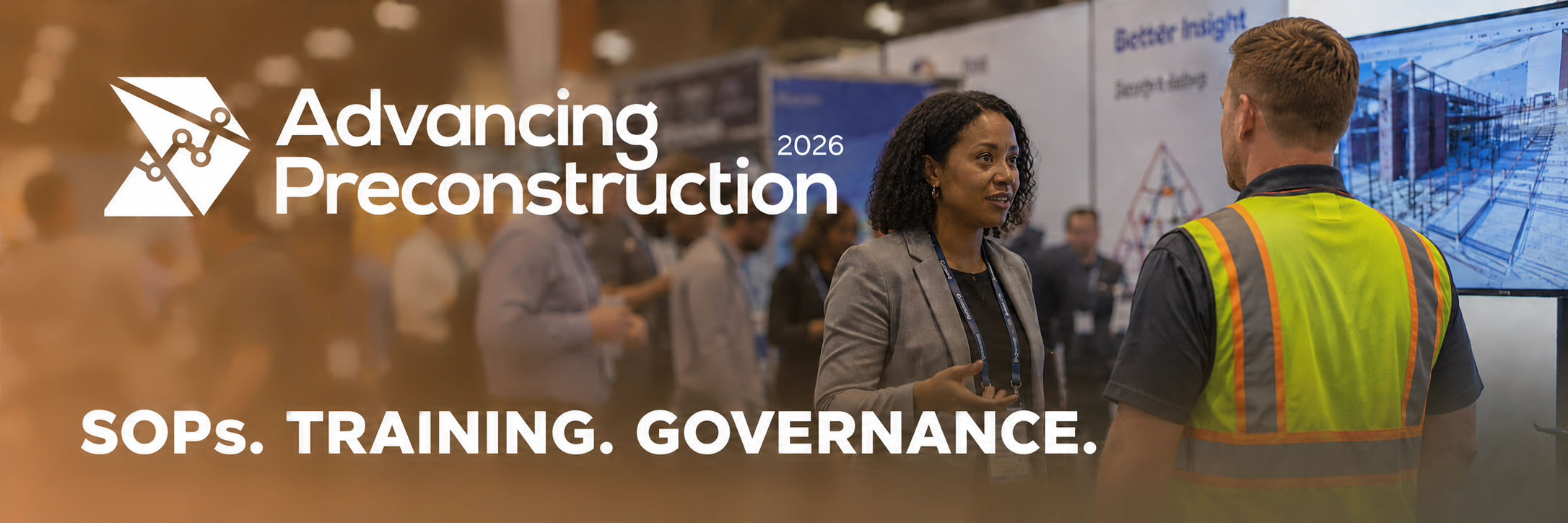
I was reviewing my notes from a recent preconstruction industry conference and came across our Service Manager’s notes and takeaways from the event. Buried in two of them was something I didn’t expect.
Two completely different construction firms. Two completely different talks. And by the end, they had said the exact same thing.
Not similar. Not adjacent. The same thing.
One was Burns & McDonnell, 15,000 employees, 100% employee-owned, infrastructure giant, the kind of firm that builds water plants and power grids across continents. The other was Gilbane, one of the oldest names in commercial building, family-owned since 1873. Different scale. Different sectors. Different audiences.
And on the same morning, in two rooms separated by a hallway, they walked Arizona builders through what amounts to the same playbook.
That doesn’t happen by accident.
The Question Everyone Was Asking
Let me set the scene.
Every preconstruction event for the last two years has had the same gravitational pull. AI. Generative AI. Agents. Models. Copilots. Vendors with booths the size of small bedrooms promising 98% accuracy and 10x productivity. The hallway chatter is “have you tried this one yet” and “did you see what they’re doing with takeoffs.”
It’s exciting. It’s also exhausting.
Because somewhere between the second espresso and the third demo, every contractor in the room has the same quiet question.
“Okay. But what do we actually DO with this on Monday?”
That’s the question Jeff Danley walked into. He runs enterprise AI strategy at Burns & McDonnell. Not a construction guy by background. Innovation, mostly. T-Mobile, Ford, United Rentals. He showed up at Burns four years ago to set up their corporate innovation program, and six months in, generative AI landed and rewrote his entire job description.
His talk had a title slide that I keep coming back to.
“Preconstruction is where AI earns its keep.”
Not where AI is fun. Not where AI is futuristic. Where AI earns its keep. That’s the language of a guy who has to justify a budget.
He laid out four reasons preconstruction is the right place to start. High document volume. Repetitive pattern work. Margin pressure. And high judgment required, meaning the work that actually matters still belongs to humans. AI clears the runway. People still fly the plane.
That last point alone separates serious operators from vendor brochures. Most AI pitches imply the machine is going to thinking and heavy lifting for you. Danley spent thirty minutes explaining why his entire team is built around the opposite premise.
What He Said Out Loud That Most Vendors Won’t
Here’s the line that should resonate with you.
“We give agents access to data. We do not train models on client work.”
Read that twice.
Burns & McDonnell uses AI every single day across its preconstruction workflows. They have an internal platform called Andi that houses purpose-built agents for estimating, RFP analysis, spec comparison, cost history, meeting notes, and document search. Their employee-owners use it constantly. But none of their client data, none of it, gets used to train the underlying models.
How? They built the governance before they built the capability.
Danley walked through it on a slide titled “We built guardrails before we built capability.” Three pillars. What they restricted. How they audit. What they learned. Sensitive client information, regulated data, and NDA-protected project details never leave approved environments. Every agent interaction is logged. Every data source is classified. They review access patterns the same way they review any other security control.
And the line that I think every Arizona contractor needs taped to their monitor:
“Guardrails that ship after the product fail. Guardrails that ship with the product become part of how people work.”
You cannot bolt this on afterward. You either build it in, or you spend the next three years apologizing to clients for things you didn’t see coming.
Then Gilbane Walked Up to a Different Microphone
A few hours later, in a different room, Gilbane took the stage. Different speaker. Different slide deck. Different industry sector, commercial building rather than EPC infrastructure.
Their opening question was simple. “What do estimators spend so much of their time on?”
The answer was a nine-square grid that any Arizona estimator could draw in their sleep. Drawings and takeoffs. Constructability reviews. Estimate creation. Early discussions with project execs. Ops coordination with superintendents and PMs. Buyout. Sub outreach. Scope reviews. Estimate delivery.
Then they flipped it.
“What would estimators spend their time on, if they had that luxury?”
Increased project volume. Strategic planning conversations with the ops team. Scenario evaluation beyond single-point estimates. Deeper trade partner conversations about scope, escalations, tariffs, and material specs.
The math here is brutal in the best way. Today’s estimator is buried in mechanical work that AI is genuinely good at. Tomorrow’s estimator is having the conversations that actually win and protect jobs. The difference isn’t the tool. It’s whether you set up your firm to make that shift.
So how do you get there? Gilbane closed with a slide they called “Revisiting Strategy.”
- Rewrite your Standard Operating Procedure and Operations Manual. Roles, responsibilities, all of it.
- Invest in training the trainers.
- Have internal townhalls to disseminate the implementation plan across the company.
- Revisit your tech stack to understand overall organizational impact.
And Now Watch What Happens
Pull Danley’s closing slide up next to Gilbane’s closing slide. He called his “Five Things Worth Trying.” Five takeaways Arizona contractors could implement on Monday.
- Build governance and capability at the same time. They are not separate.
- Audit your data before you audit your AI tools. The bottleneck is almost never the model.
- Treat AI literacy like safety training. Baseline, refreshed, mandatory.
- Write SOPs with two audiences in mind: new employees and AI agents.
- Pick one painful workflow. Solve it well. Then scale.
Two firms. Two stages. Two completely independent strategies arrived at by two completely independent teams. And the overlap is almost word-for-word.
SOPs. Training. Governance. Pick a workflow.
Nobody at either company said “buy this tool.” Nobody said “AI will replace your estimators.” Nobody said “you need a six-figure platform to compete.”
They said the boring stuff is the whole game.
Why That Should Land Hard With Arizona Builders
If you’re running an Arizona contractor with 35 employees, you might read the above and think “easy for them, they have innovation directors and 15,000 people to underwrite the bet.”
I’d push back on that.
Burns & McDonnell isn’t winning at AI because they’re big. They’re winning because they refused to treat AI as a magic input. They treated it as a system that has to live inside everything else: data governance, employee training, SOP documentation, role-based access, audit trails.
A 35-person contractor in Tempe has the exact same four ingredients. The scale is different. The discipline isn’t.
Here’s what’s actually true for a mid-sized Arizona AEC firm trying to figure out where to start.
- Your data is the lever, not the model. Danley said it three times. The bottleneck is almost never the AI. It’s the dirty estimate data, the half-finished SOPs, the cost codes that mean five different things across five different project managers. Cleaning that up is unglamorous, but it’s where the real return lives.
- SOPs are the new AI training data. Gilbane and Danley both ended at the same place. If your operations manual is a binder from 2017 that nobody opens, your AI rollout will fail before it starts. The reason isn’t technical. It’s that nobody can teach an agent what your firm actually does if your firm has never written it down.
- Treat AI literacy like a safety standard, not a tech project. Danley’s frame here was perfect. Safety training is baseline, refreshed, and mandatory. Nobody asks if it’s worth doing. AI literacy needs the same posture. The risk of an untrained estimator pasting bid documents into a free consumer AI account is real, and it’s already happening on your jobs.
- Pick one painful workflow. Just one. This is the most countercultural advice in the entire conference. Every vendor wants to sell you a platform. Every keynote wants to talk about transformation. Two of the most respected speakers said the same thing: solve one workflow well, then scale. That’s how you build momentum without breaking your operations.
What We Are Doing With This
We’ve already started using both decks as a teaching tool with the Arizona contractors we work with. The Danley playbook is, frankly, what doing this right looks like at scale. The Gilbane talk is what doing it right looks like when you’re still figuring out the shape of the problem.
For most Arizona AEC firms, the honest starting point is the data and SOP side. Not the AI side. That’s the unglamorous truth that gets buried under the demo videos.
And that’s exactly what we’re doing in Session 2 of our AI in Construction series with Rowan Steel-Hall on June 11. Hands-on workshop. No vendor pitches. Real preconstruction scenarios. Built around the same five takeaways Danley laid out on Day 3, including the one about picking one painful workflow and solving it well.
If you want to actually try this in a room of Arizona builders rather than read another think piece about it, register in the link below.
The boring stuff is the whole game. Two of the most respected names in the industry just said so out loud, on the same day, in two rooms across the hall from each other.
Time to write some SOPs and get building.
For over 20 years, Computer Dimensions has been the trusted IT partner for Arizona's architecture, engineering, and construction industry. We help AEC firms communicate better, collaborate smarter, and actually use the technology they've invested in. Because in construction, the tools only work if your team does.
IT Built For Builders.
AI In Construction Part 2 – The Live Build Workshop
